Just Seven Things

Exploring why and how we do what we do, and how we can do it better

Archive for the category “Neuroscience”

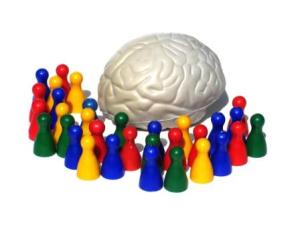
Using Neuroscience to Train Frankinstein Leaders?

Work has been undertaken which suggests that the behavioural and emotional qualities of leadership can be traced to neurological activity in identified regions of the brain.

In a really practical step, Pierre Balthazard at Arizona State Uni. is then working on linking this activity with the qualities that best benefit those at the top of a company to create training techniques that develop effective leadership abilities.

The FT reports on this in their article ‘A Brainwave in the Study of Leadership‘, noting that more recently leadership research has focused on more complex issues, ‘how to develop traits such as authenticity, charisma and visionary and inspirational leadership in less talented leaders’

Everything centres around evidence and belief that training (and subsequent scanning and rescanning) can show evidence of changes in signature brain patterns for certain behaviours: ‘neuro-feedback training can develop the behaviour individuals want to optimise’

Balthazard has gathered evidence he believes to be 100% accurate in determining who is  a strong leader (a bold claim….). He has also discovered that leaders with ‘high psychological capital’ – such as hope, optimism and resilience – display different brain activity.

Applications are obvious, and the US Military Academy at West Point and global management schools are looking at patterns that can be copied. It’s not surprising however that funding has been hard to find, and that there are obvious detractors (quoting 1984/ Orwellian Big Brother nightmare scenarios….)

For me, I feel intuitively that making such fundamental changes can’t be as simple as learning how to make lights flash differently on one screen to match a prescribed ‘best’ pattern on the other.

Apologies to Balthazard and his team for making such sweeping conclusions with such little evidence.  I’m sure it’s probably because I don’t want to admit that we’re absolutely as simple to change as all this. For me however, understanding; appreciation of how things overall ‘fit together’ and underlying values seem like bigger pieces of the equation of leadership excellence that cannot be trained so easily.

Creativity and the Business Brain (and Why Most of Us Should be Sacked)

Thinking Out of the Box by Svilen Mushkatov

Thinking Out of the Box by Svilen Mushkatov

Your position of responsibility gives you the stress of deadlines, targets and deliverables. The development of your people, your management responsibilities and your career development weigh heavily on you. Continuing professional development, business/ competitor intelligence and your near-term product and service evolution/ development nag away at the peripheries of your to-do list and stress consciousness.

The environment in which you and your business is operating, the competitive threats and the strategic developments that you should be plotting and planning in response seem like things that are always on next week or month’s agenda.

The reality – when you make the time – is that your your day to day responsibilities drown your brain space and creativity. Like digging a hole in the sand on the shoreline, as quickly as you try and dig out the brain space, the sea water of your hard deadlines, actions and targets fills the hole. Even if you adopt a disciplined approach to your time you often get to the allotted slot for your creativity and…….. nothing…… you’re not in a creative place or mindset, nothing flows. Or even if it does, it’s a long time coming and you’re vaguely aware afterwards that there was a lot more to come if only you’d been in the right mindset.

If you’re practiced at being creative, inventive, innovative and lateral then you’ll recognise the mind set you need. You’ll know what state you need to be in to originally produce and generate new thought or ideas. You may only know this hazily through a series of post-event analyses of your most creative moments. Or this may be the first time you’ve really thought about it all that deeply. But hazily is the key, and at the heart of the dichotomy of managing creativity in business (to be clear, I’m not talking here about managing creative teams, but the extension in thinking and reasoning should be fairly obvious by the end of this post) Read more…

Brain Training When We Only Have a Neanderthal Syllabus

Brainy People by Sanja Gjenero

Brainy People by Sanja Gjenero

The difficult balance we have to manage as human animals with a brain of two hemispheres is contrasted well in Will’s comment. Independent but obviously joined and synergistic. It’s how well we know about how the different personalities of our brain work together that is one of the roots of our personal effectiveness and success.

The planned, logical and rigorous administrator on the left wants to analyse, intepret and categorise. It gives a script to our experience of the world and our interactions within it.

The creative, artistic lateral thinker on the right wants to muse, develop, connect and expand. It experiences our world and our interactions within it, and is the source of apparently independent creative thoughts, ideas and constructions.

The administrator and the artist live together very happily for the purposes of you being born, living a life and dieing. Whether you have optimised either your happiness or potential greatness over this lifespan (assuming a positive desire to do this) is a matter of better understanding:

– how the artist and administrator work together best as a team. Their preferences, strengths and weaknesses: how they can organise themselves better to bring out the best of each other

– how they conflict. Their allowable weaknesses (in Belbin’s terms) are best handled when transparent, articulated and understood (without emotion or frustration)

– how your conscious handling of their other-than-conscious behaviours can also help improve their relationship and productivity as a unit – or not

Each of these three bullets is at least a shelf of potential books in your local bookstore. Add in the extra dimensions of personal preferences/ personality type/ psychometrics and energy levels/ chemical mood impacts, and you end up with a smörgåsbord of levers/ techniques/ aspects to manage. Throw in the fact that this analysis is framed by only a conscious assessment of the tip of the neuroscience iceberg. That we have both the rest of the visible (current consciously understood) iceberg to explore, as well as the vast depths underwater.

It may mean it is a long time before we are capable of consciously understanding how to optimise our happiness or potential greatness.

Further thought: Interesting research ‘The human brain is on the edge of chaos’

Post Navigation